'%3e%3cpath%20d='M706.453%20375.999C860.234%20375.999%20984.899%20291.829%20984.899%20188C984.899%2084.1703%20860.234%200%20706.453%200C552.671%200%20428.006%2084.1703%20428.006%20188C428.006%20291.829%20552.671%20375.999%20706.453%20375.999Z'%20fill='%23009B4F'/%3e%3cpath%20d='M278.447%20375.999C432.229%20375.999%20556.893%20291.829%20556.893%20188C556.893%2084.1703%20432.229%200%20278.447%200C124.665%200%200%2084.1703%200%20188C0%20291.829%20124.665%20375.999%20278.447%20375.999Z'%20fill='%23009B4F'/%3e%3cpath%20d='M141.484%20166.68C125.01%20162.158%20114.996%20158.927%20114.996%20150.529C114.996%20143.422%20122.102%20138.9%20133.085%20138.9C144.068%20138.9%20155.051%20143.099%20164.095%20150.529L164.418%20150.852L165.388%20129.855C156.666%20125.01%20147.944%20121.78%20133.731%20121.78C123.394%20121.78%20114.027%20124.364%20107.243%20129.209C99.8137%20134.378%2095.9374%20142.13%2095.9374%20151.175C95.9374%20168.941%20110.796%20176.694%20123.394%20179.924C140.192%20184.446%20151.821%20188.323%20151.821%20198.659C151.821%20207.381%20144.068%20212.872%20131.47%20212.872C118.872%20212.872%20106.274%20207.381%2096.5834%20198.013L96.2604%20197.69L94.3223%20219.979C104.336%20226.762%20116.934%20230.316%20130.501%20230.316C142.13%20230.316%20152.144%20227.408%20159.25%20221.917C167.003%20216.103%20171.202%20207.704%20171.202%20197.367C171.202%20181.862%20161.511%20171.848%20141.484%20166.68Z'%20fill='white'/%3e%3cpath%20d='M264.557%20188C264.557%20215.78%20246.467%20230.316%20225.471%20230.316C215.457%20230.316%20207.381%20226.762%20201.244%20221.271V253.896H182.186V146.976H201.244V156.02C207.704%20149.883%20216.103%20145.684%20226.763%20145.684C247.436%20145.36%20264.557%20160.22%20264.557%20188ZM245.498%20188C245.498%20172.494%20236.131%20162.158%20222.887%20162.158C214.811%20162.158%20207.058%20165.711%20201.567%20173.787V203.182C207.058%20210.288%20214.488%20213.841%20222.887%20213.841C236.131%20213.841%20245.498%20203.505%20245.498%20188Z'%20fill='white'/%3e%3cpath%20d='M352.095%20194.137H294.274C296.535%20207.058%20305.903%20213.841%20318.824%20213.841C329.807%20213.841%20337.882%20211.257%20346.604%20206.089L347.573%20222.886C339.82%20227.085%20330.13%20230.316%20317.532%20230.316C294.274%20230.316%20274.893%20215.78%20274.893%20188.323C274.893%20162.804%20294.274%20145.683%20317.209%20145.683C341.112%20145.683%20353.71%20160.22%20353.71%20181.216C353.71%20185.415%20353.064%20189.615%20352.095%20194.137ZM335.621%20178.632C335.621%20168.618%20329.161%20160.866%20317.532%20160.866C306.549%20160.866%20296.858%20168.295%20294.597%20180.893H335.298C335.621%20180.247%20335.621%20179.601%20335.621%20178.632Z'%20fill='white'/%3e%3cpath%20d='M443.189%20221.917L445.128%20203.505C452.88%20209.965%20463.54%20213.841%20474.846%20213.841C482.921%20213.841%20488.413%20210.611%20488.413%20204.797C488.413%20189.615%20444.482%20197.367%20444.482%20169.91C444.482%20153.436%20458.695%20145.36%20475.492%20145.36C487.444%20145.36%20496.488%20148.268%20503.272%20152.467L502.303%20169.587C494.227%20164.096%20484.213%20161.189%20475.492%20161.189C468.708%20161.189%20463.217%20163.773%20463.217%20168.941C463.217%20181.862%20507.471%20175.402%20507.471%20203.828C507.471%20221.271%20492.289%20229.993%20474.523%20229.993C461.602%20230.316%20450.942%20227.085%20443.189%20221.917Z'%20fill='white'/%3e%3cpath%20d='M590.488%20177.986V228.701H571.429V220.302C564.969%20226.439%20556.57%20229.993%20546.88%20229.993C528.467%20229.993%20517.484%20219.01%20517.484%20203.505C517.484%20187.03%20530.405%20177.017%20549.464%20177.017C556.57%20177.017%20563.677%20178.309%20571.752%20180.57V177.986C571.752%20165.388%20562.385%20159.897%20550.756%20159.897C542.034%20159.897%20532.02%20163.127%20524.914%20168.941L524.268%20152.467C530.405%20148.268%20541.711%20145.037%20554.309%20145.037C574.983%20145.36%20590.488%20155.374%20590.488%20177.986ZM571.429%20206.735V194.46C564.646%20192.199%20558.185%20190.907%20551.402%20190.907C541.711%20190.907%20535.574%20196.075%20535.574%20203.505C535.574%20210.934%20542.034%20215.78%20550.433%20215.78C558.508%20215.78%20564.969%20212.872%20571.429%20206.735Z'%20fill='white'/%3e%3cpath%20d='M592.104%20146.976H612.777L636.358%20198.659L659.616%20146.976H680.289L641.526%20228.701H630.866L592.104%20146.976Z'%20fill='white'/%3e%3cpath%20d='M754.907%20194.137H697.409C699.67%20207.058%20709.038%20213.841%20721.959%20213.841C732.941%20213.841%20741.017%20211.257%20749.739%20206.089L750.708%20222.886C742.955%20227.085%20733.264%20230.316%20720.667%20230.316C697.409%20230.316%20678.027%20215.78%20678.027%20188.323C678.027%20162.804%20697.409%20145.683%20720.343%20145.683C744.247%20145.683%20756.845%20160.22%20756.845%20181.216C756.522%20185.415%20756.199%20189.615%20754.907%20194.137ZM738.756%20178.632C738.756%20168.618%20732.295%20160.866%20720.667%20160.866C709.684%20160.866%20699.993%20168.295%20697.732%20180.893H738.433C738.433%20180.247%20738.756%20179.601%20738.756%20178.632Z'%20fill='white'/%3e%3cpath%20d='M826.618%20148.914L824.034%20166.357C819.511%20163.773%20814.989%20163.127%20810.467%20163.127C802.068%20163.127%20794.315%20167.326%20788.824%20176.371V228.701H769.766V146.976H788.824V157.958C794.315%20150.529%20802.068%20145.36%20812.728%20145.36C817.896%20145.36%20822.418%20146.653%20826.618%20148.914Z'%20fill='white'/%3e%3cpath%20d='M832.109%20221.917L834.048%20203.505C841.8%20209.965%20852.46%20213.841%20863.766%20213.841C871.841%20213.841%20877.333%20210.611%20877.333%20204.797C877.333%20189.615%20833.401%20197.367%20833.401%20169.91C833.401%20153.436%20847.615%20145.36%20864.412%20145.36C876.364%20145.36%20885.408%20148.268%20892.192%20152.467L891.223%20169.587C883.147%20164.096%20873.133%20161.189%20864.412%20161.189C857.628%20161.189%20852.137%20163.773%20852.137%20168.941C852.137%20181.862%20896.391%20175.402%20896.391%20203.828C896.391%20221.271%20881.209%20229.993%20863.443%20229.993C850.522%20230.316%20839.862%20227.085%20832.109%20221.917Z'%20fill='white'/%3e%3cpath%20d='M429.298%20206.412C422.838%20211.257%20416.054%20213.841%20408.302%20213.841C395.058%20213.841%20383.429%20204.474%20383.429%20188C383.429%20171.525%20395.058%20162.158%20408.302%20162.158C416.054%20162.158%20422.838%20164.742%20429.298%20169.264C430.268%20163.45%20431.237%20157.958%20432.852%20152.467C426.068%20148.591%20417.67%20145.683%20406.041%20145.683C382.783%20145.683%20363.725%20161.512%20363.725%20188C363.725%20214.487%20382.783%20230.316%20406.041%20230.316C417.67%20230.316%20426.068%20227.085%20432.852%20222.886C431.237%20217.395%20429.944%20211.903%20429.298%20206.412Z'%20fill='white'/%3e%3c/g%3e%3cdefs%3e%3cclipPath%20id='clip0_1478_9029'%3e%3crect%20width='984.9'%20height='375.999'%20fill='white'/%3e%3c/clipPath%3e%3c/defs%3e%3c/svg%3e)
What is myopia?
Short‑sightedness, also known as myopia, is very common in the UK. It's when you can see things clearly up close but struggle with distant objects. Short sight affects millions of people and usually develops during childhood or teenage years. It's easy to treat.
Symptoms of myopia
The main symptom is struggling to see distant objects clearly, but this can be accompanied by other signs that may indicate myopia is developing or getting worse:
Squinting to see distant objects – This is often the first sign parents notice in children, like squinting at the TV, the whiteboard at school, or road signs.
Headaches and eye strain – Constantly trying to focus on distant objects can cause headaches and tired eyes, especially after activities like driving or watching TV.
Sitting closer to screens or books – Children might move closer to the TV or hold books very close to their faces to see clearly.
Difficulty seeing the board at school – Teachers often notice when children can't read what's written on the classroom whiteboard or struggle to see presentations.


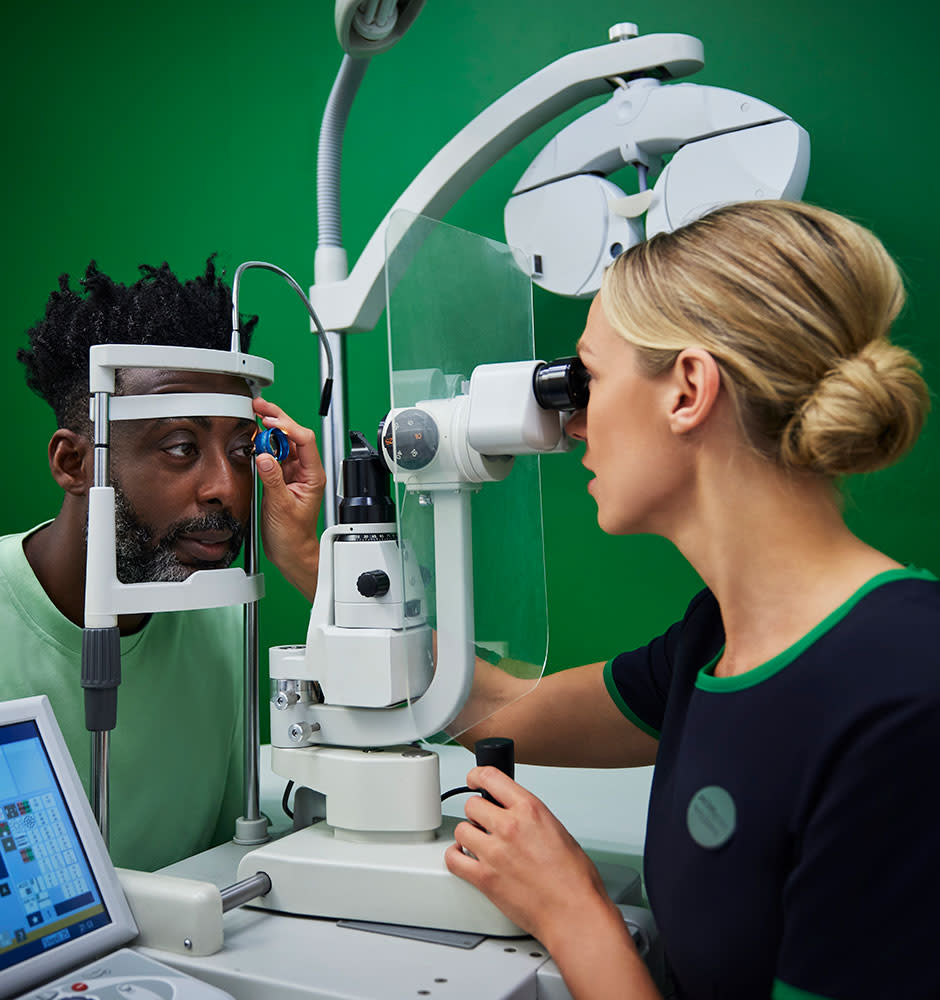
Do these symptoms sound familiar?
If you have experienced any of the symptoms mentioned above it's worth booking an appointment with one of our optometrists.
Short‑sightedness vs. long‑sightedness
It can be tricky to tell the difference between short‑sightedness and other vision problems. Short‑sightedness means distant objects look blurry while close‑up things stay clear. Long‑sightedness is the opposite. You might struggle with reading or close work, but see distant objects more clearly. Both conditions can occur alongside presbyopia, which affects near vision as we age.
Who's more likely to develop myopia?
Short‑sightedness often runs in families, so children with short‑sighted parents are more likely to develop it. It typically starts during childhood or teenage years when the eyes are still growing. Modern lifestyle factors also increase risk. Children who spend more time indoors, do lots of close‑up work, or have limited outdoor time are more prone to developing myopia.
Experience it for yourself
If you've ever wondered what it would be like to be short‑sighted, our vision simulator helps to give some answers.
Move the slider below to see how their vision might look.


Disclaimer: For advice and further information about short‑sightedness you should consult an eye care professional. This Vision Simulator should be treated as information only and does not represent advice. The images presented are artistic interpretations of short‑sightedness as experienced without glasses or contact lenses.
Vision simulator reproduced with permission from CooperVision Inc. and its subsidiaries.
Causes of myopia
Short‑sightedness makes distant objects look blurry due to how light focuses.
Eye length
Myopia is usually caused by the eye being too long from front to back, which means light focuses in front of the retina instead of directly on it.
Curved cornea
The cornea is the clear front layer of your eye that bends light as it enters. In myopia, the cornea may be too curved, causing images to fall short of the retina.
Changes to the lens
Located behind the cornea, the lens fine‑tunes focus. Changes to the lens, such as with cataracts, can sometimes contribute to short‑sightedness symptoms.
Genetic factors
Genetic factors play a significant role in the development of myopia, increasing the likelihood if one or both parents are affected, though it is not guaranteed.
Environmental factors
Environmental factors also play a role, such as spending lots of time on close‑up activities like reading or screen time, combined with not getting enough natural daylight.
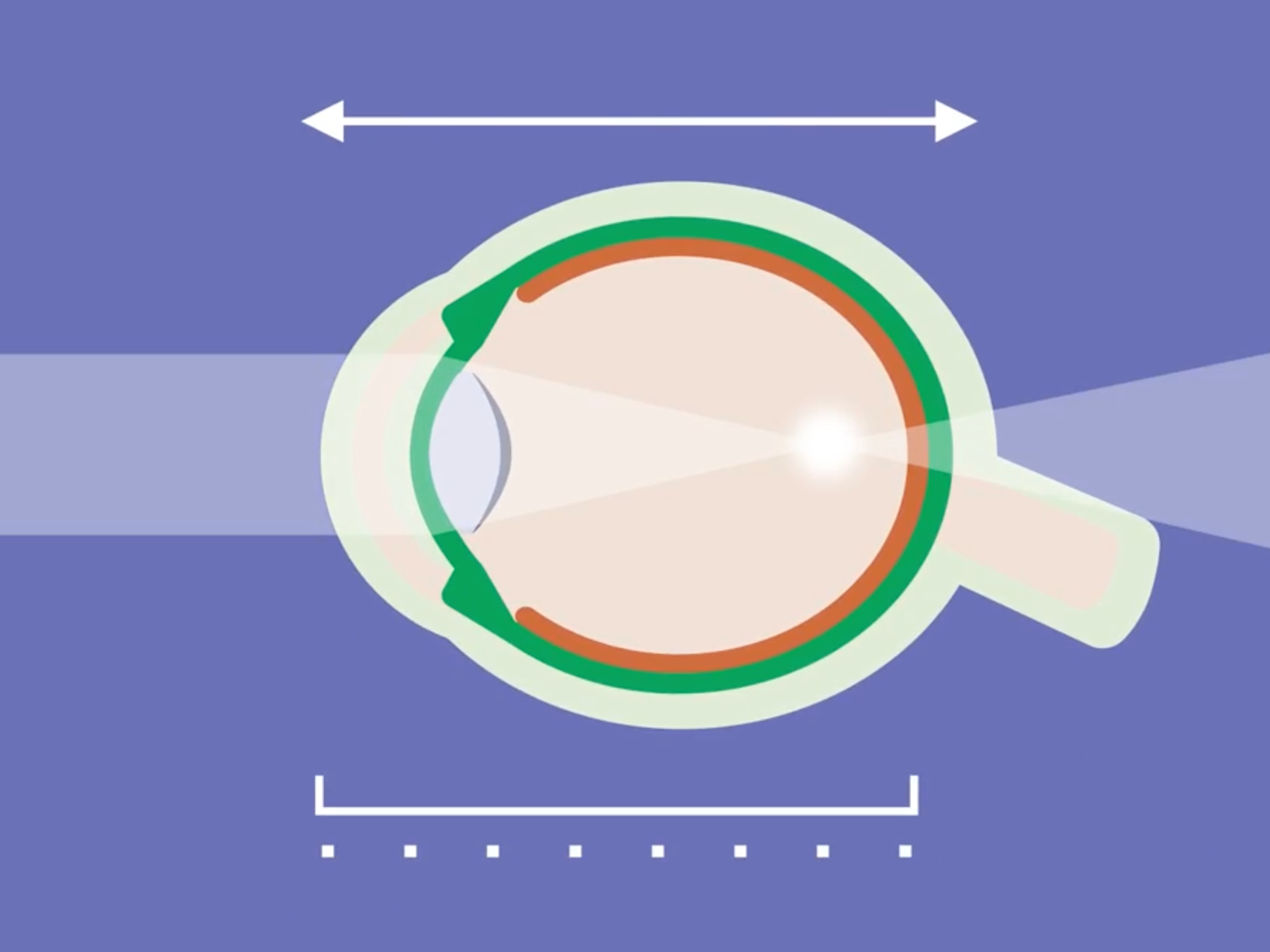
Illustration shows that myopia happens when the eyeball grows too much, stretching so that the distance from front to back is longer than it should be.
How is short‑sightedness diagnosed?
An optometrist can diagnose myopia by performing a comprehensive eye exam. They'll check how well you can see at different distances and examine the health of your eyes. Understanding how the eye works helps explain why these tests are so important for detecting short‑sightedness early, especially in children.
The diagnosis of myopia typically involves:
Patient history – Your optometrist will ask about symptoms, family history of short‑sightedness, and lifestyle factors like screen time and outdoor activities.
Visual acuity test – This measures how clearly you can see letters on a chart at different distances, helping determine the severity of myopia.
Refraction test – Using different lenses, your optometrist finds the exact prescription needed to correct your short‑sightedness.
Eye health examination – A thorough check of your eyes' internal structures to rule out other conditions and assess overall eye health.
Why early eye tests matter (especially for kids)
Regular eye examinations are crucial for detecting and managing myopia, particularly in children whose vision can change rapidly. Early detection allows for prompt correction and, importantly, the implementation of myopia control strategies that can significantly impact long‑term eye health.
Fast‑changing eyesight in children – Children's eyes develop rapidly, and myopia often begins during school years when visual demands increase significantly. Many children don't realise their vision is changing because the progression is gradual.
Professional monitoring and intervention – Regular professional eye examinations allow optometrists to track not just prescription changes, but also the health of the developing eye using advanced imaging techniques.
Specialised myopia management – For children showing rapid myopia progression, specialised myopia management programmes can be started early, potentially preventing the development of high myopia and its associated risks later in life.
Treatment for short‑sightedness
Short‑sightedness is really common. We'll help you or your child see clearly and keep their eyes healthy. The good news is that there are several effective ways to correct myopia, and the right choice depends on your age, lifestyle, and how quickly your prescription is changing.
Glasses for myopia
Glasses are still the most common and safest way to correct short‑sightedness, particularly in children. They use concave (minus) lenses to refocus light onto the retina, which sharpens distance vision straight away. Beyond correcting sight, certain types of glasses are designed to slow down the progression of myopia. These myopia management lenses use technologies such as peripheral defocus and dual‑focus designs. Studies show they can reduce myopia progression by around 30‑60% compared to standard single‑vision lenses.
Contact lenses and other options
As children grow older and become more responsible, contact lenses can offer greater freedom for sports and social activities. Daily disposable contact lenses are often the safest option for teenagers, reducing the risk of eye infections. Specialised contact lenses, such as multifocal designs, can also help slow progression while providing clear vision. For rapidly progressing myopia or very high prescriptions, specialist intervention may be necessary, including orthokeratology (overnight contact lenses that reshape the cornea), atropine eye drops to slow progression, and specialised myopia management.
Book an eye testMyopia in children
If your child is complaining about short‑sightedness, headaches, eye strain, or even feeling tired, then they may have myopia.
Progressive myopia happens when the condition progresses rapidly. This affects young children in particular, so it’s important to start myopia management treatment as soon as possible. As well as the symptoms listed above, children with short‑sightedness may experience:
Difficulty seeing in into the distance/holding objects close to the face
Headaches
Excessive blinking
Fatigue and lack of concentration
Clumsiness
Eye rubbing
If you are concerned about myopia, then the best step is to take your child for an eye test. Children can be tested at any age, even if they can’t read or talk yet.
Myopia management for children
Children can use 'myopia management’ products to help control their condition. This involves using contact lenses or glasses lenses specially designed to help minimise progression specifically in children.
Specsavers offers myopia management glasses lenses or contact lenses and our eye care professionals will talk you through both options and help you to pick the best one for your child.
Alongside glasses or contact lenses, other ways to help manage myopia include:
Encouraging them to spend at least two hours outdoors daily
Limiting screen time
Taking breaks from close‑up tasks
Ensuring they get a good night's sleep
Myopia management products
Your optician will help you choose the best solution for your child’s needs
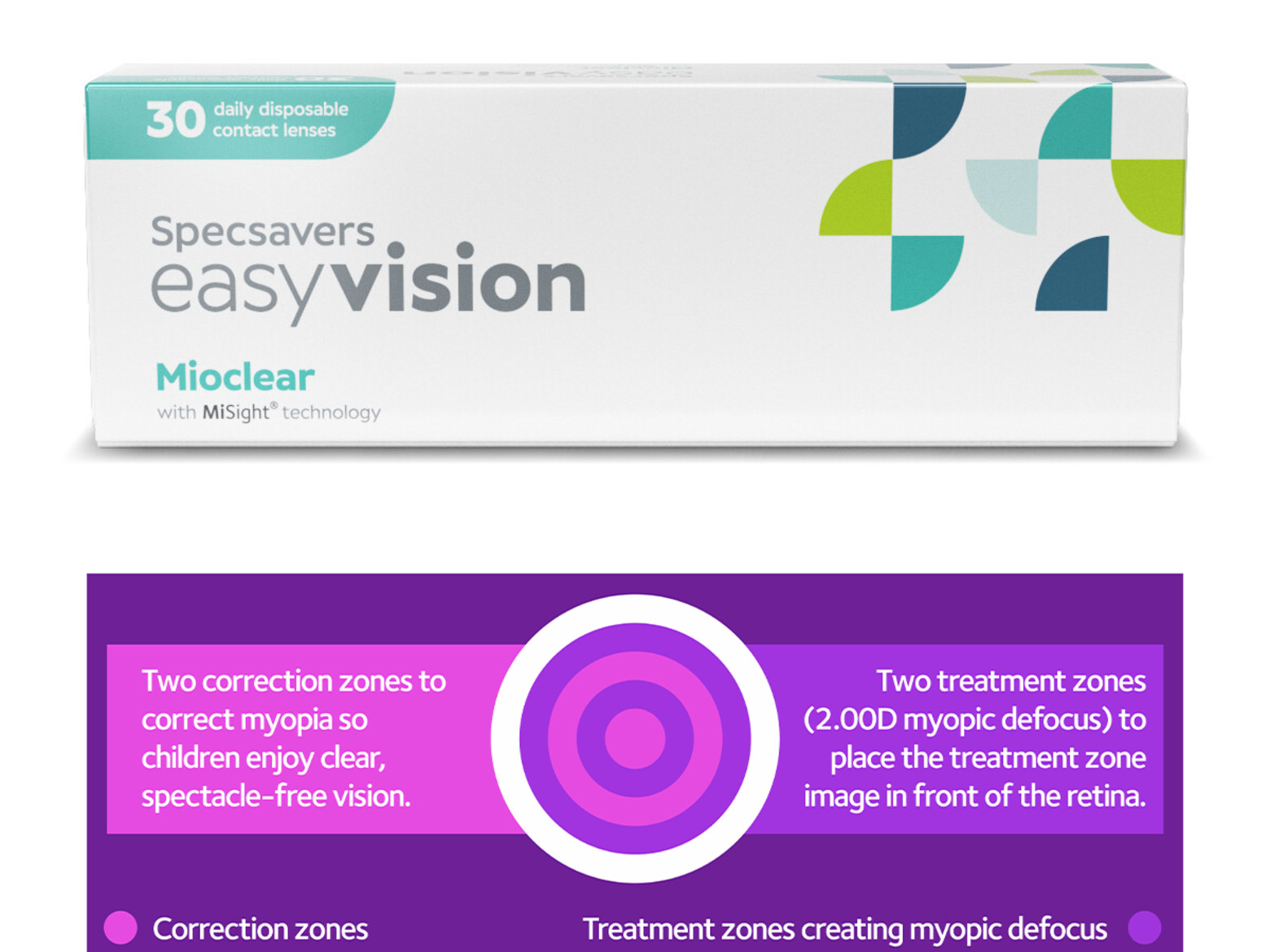
Specsavers easyvision Mioclear1 contact lenses
£36 per month, including sight tests/ delivery and health checks (easycare subscription2)
easyvision Mioclear1 are convenient, single‑use lenses that don't require cleaning, solutions, or storage. Your child starts with a comfortable, fresh pair of lenses every day.
easyvision Mioclear1 contact lenses are dual‑purpose: they provide clear vision and help to slow the worsening of myopia3 during your child’s crucial growing years4 when enjoying an active lifestyle is so important.
easyvision Mioclear1 contact lenses feature MiSight® technology, they are child‑friendly and easy‑to‑use3.
If your child’s myopic prescription increases by ‑0.50 (best sphere) or more within a 14‑month period, we will replace one pair of lenses free of charge.
Your Optometrist will discuss any changes found and advise.
Packaging images are for illustration only.
easyvision Mioclear is a brand variant of MiSight® 1 day. Mioclear features the same technologies as used in MiSight® 1 day.
easycare subscription includes; sight tests, contact lens healthchecks, delivery, replacement lenses, see t&cs: Easycare contact lens package | Specsavers UK
Chamberlain P, et al. A 3‑year randomized clinical trial of MiSight® lenses for myopia control. OVS 2019; 96(8):556‑567.
K. Zadnik et al. Factors Associated with Rapid Myopia Progression in School‑aged Children. IOVS 2004;45(13):2306.
For more information on children’s eye health, check out these related topics:
All about children's eyecare
Find out moreChildren's contact lenses
Find out moreOur range of children's glasses
View all
Complications
Most instances of myopia are fairly mild and can be easily treated. However, people with severe cases could be at a risk of developing other eye conditions such as:
Glaucoma – an eye disease which damages the optic nerve, causing blurry vision.
Retinal detachment – a serious eye condition which can affect your vision and potentially lead to vision loss.
Cataracts – a common condition which causes blurred or cloudy vision
Should you be at risk of developing these issues, regular eye tests including an OCT scan can help detect these early on.

Eye health and conditions
View a range of eye conditions and vision problems alongside helpful information about their symptoms & treatment.
Can I prevent myopia from developing?
Prevention and early intervention are key to managing myopia effectively. While we can't always prevent short‑sightedness from developing, we can take steps to reduce the risk and slow its progression:
Get outside for 2 hours a day
Take breaks from screens
Book regular eye checks
Be aware of family history and discuss it with your optometrist.
Short‑sightedness FAQs
There isn’t a cure for myopia, but it can be managed very effectively. Glasses and contact lenses correct vision straight away, and modern myopia management options can slow down how quickly it worsens. For most people, myopia is easily controlled and doesn’t stop them from enjoying everyday life.
Myopia often begins in childhood or the teenage years, usually between the ages of 6 and 14. It tends to get worse as the eye grows, which is why regular eye tests are so important during school years. For many people, their prescription stabilises in early adulthood once eye growth slows down.
Spending time on screens doesn’t directly cause myopia, but long periods of close‑up work without breaks can make it more likely to progress. This includes reading, homework, and device use. Research shows that a good balance helps – limiting long sessions of close work, encouraging outdoor time, and following the 20‑20‑20 rule can all support healthy vision.
Yes, short‑sightedness usually progresses during childhood and teenage years, as the eyes are still developing. This means prescriptions may need to be updated regularly. In most cases, it levels off in early adulthood. For children with rapidly changing eyesight, myopia management strategies such as specialist glasses or contact lenses can help slow progression.
Myopia (short‑sightedness) makes it hard to see distant objects clearly and usually begins in childhood. Presbyopia is different – it affects near vision and happens naturally as we age, often from around age 40 onwards. It’s possible to have both myopia and presbyopia, meaning you may need different types of correction depending on what you’re looking at.
High myopia, usually defined as a prescription stronger than ‑6.00 dioptres, can increase the risk of certain eye conditions later in life. These include detached retina, glaucoma, and myopic macular degeneration. While these complications are rare, regular eye tests are vital to keep an eye on changes and spot any problems early.
No, children don’t grow out of myopia. Once it develops, it usually needs lifelong correction. The good news is that with modern glasses, contact lenses, and myopia control options, vision can be corrected easily, and progression can often be slowed down.
Yes. Studies consistently show that children who spend more time outdoors are less likely to develop myopia and, if they already have it, tend to experience slower progression. Natural daylight seems to play a protective role in healthy eye growth. Just two hours outdoors each day can make a difference.
If your child is diagnosed with myopia, they’ll usually need to wear glasses most of the time to see clearly at school and in daily life. Some children may only need them for certain activities, like seeing the board at school or watching TV, but most benefit from full‑time wear. Your optometrist will give personalised advice.
It’s much more common for myopia to start in childhood, but adults can sometimes develop it too, particularly if they have health conditions such as diabetes or cataracts. Adults with new or worsening blurry distance vision should book an eye test to rule out underlying causes.
Written by our experts for peace of mind

Ross Campbell
Related conditions
Not sure if this is what you’re experiencing? Explore some related conditions:
Astigmatism
This is simply an imperfection in the shape of your eye that affects how you see.
Find out moreDetached retina
In some cases, the retina can get detached, cutting off the blood supply so the cells in the retina stop working.
Find out moreMacular Degeneration
An eye disease caused by deterioration of the macula — a small area in the centre of the retina (the light‑sensitive part of the eye).
Find out more
Find out more about eye care services
All eye conditions
Read more information about all eye conditions.
View all eye conditions
Book an eye test
Book an appointment at your local Specsavers store.
Book an eye test
All about eye tests
Everything you need to know about getting your eyes tested.
Find out more
Fricke, T. et al., (2019) Optical interventions to slow the progression of myopia. Journal of Clinical & Experimental Ophthalmology. Available at: https://www.ncbi.nlm.nih.gov/articles/PMC6688415/
(Accessed: 19 August 2025)Lam, C.S.Y. et al., (2023) Long‑term myopia control effect and safety in children wearing DIMS spectacle lenses. Scientific Reports. Available at: https://www.nature.com/articles/s41598‑023‑32700‑7
(Accessed: 19 August 2025)Review of Myopia Management, (2025) The College of Optometrists: Childhood‑onset myopia management: Evidence review Available at: https://www.college‑optometrists.org/category‑landing‑pages/clinical‑topics/myopia/childhood‑onset‑myopia‑management‑evidence‑review
(Accessed: 19 August 2025)Russo, A. et al., (2022) Myopia: Mechanisms and strategies to slow down its progression. Journal of Ophthalmology. Available at: https://www.ncbi.nlm.nih.gov/articles/PMC9213207/
(Accessed: 19 August 2025)Zhang, J. et al., (2019) Protective effects of increased outdoor time against myopia. Journal of Ophthalmology. Available at: https://www.ncbi.nlm.nih.gov/articles/PMC7607527/
(Accessed: 19 August 2025)Li, D., (2024) Spending more time outdoors can prevent onset of myopia, but not slow its progression. Karger. Available at: https://pubmed.ncbi.nlm.nih.gov/38710180/
(Accessed: 19 August 2025)The College of Optometrists, (2025) Childhood‑onset myopia management: evidence review. Available at: https://www.college‑optometrists.org/category‑landing‑pages/clinical‑topics/myopia/childhood‑onset‑myopia‑management‑evidence‑review
(Accessed: 19 August 2025)Optometrists.org, (2025) Myopia management: the optical strategy. Available at: https://www.optometrists.org/general‑practice‑optometry/guide‑to‑myopia‑management/myopia‑management/myopia‑management‑the‑optical‑strategy/
(Accessed: 19 August 2025)